

When AI Gets It Wrong: A Florida Man Says Facial Recognition Put Him in Handcuffs
The Robert Dillon lawsuit is not just a police story. It is a warning about what happens when institutions trust artificial intelligence more than evidence.
Robert Dillon says he was arrested for a crime he did not commit in a city he had never visited.
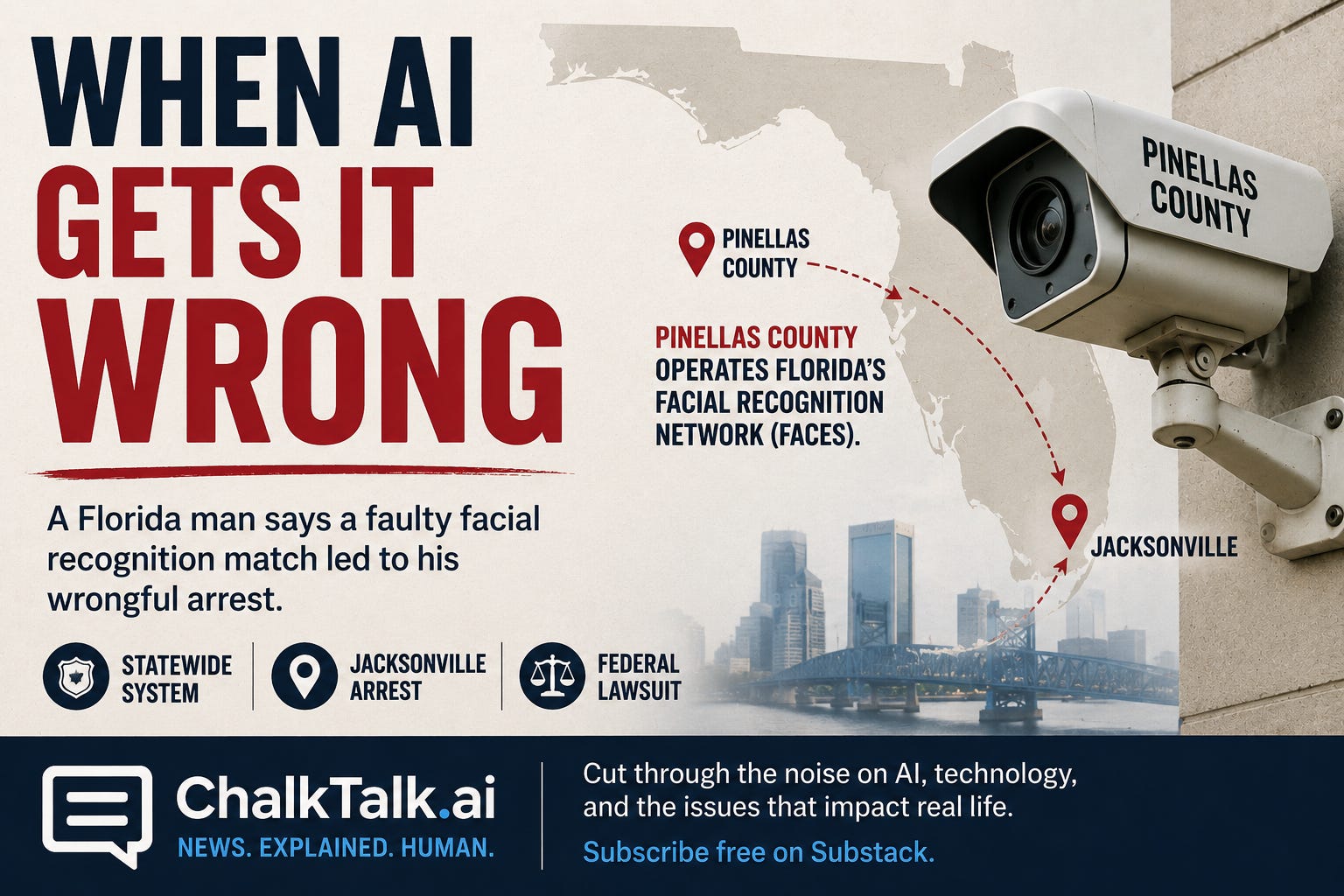
Dillon, a Fort Myers commercial crabber, has filed a federal lawsuit after what the ACLU describes as a false facial recognition match helped turn him into a suspect in a 2023 Jacksonville Beach child-luring investigation. The lawsuit names the Jacksonville Beach Police Department, the Jacksonville Sheriff’s Office, and Pinellas County Sheriff Bob Gualtieri in his official capacity.¹
The facts alleged in the lawsuit are disturbing because they show the difference between using artificial intelligence as a tool and allowing artificial intelligence to become a substitute for judgment.
According to the ACLU, police used a grainy image of a suspect and ran it through FACES, a facial recognition system operated by the Pinellas County Sheriff’s Office. The system reportedly returned Dillon as a 93% match.²
That sounds scientific. It sounds precise. It sounds like the machine “knew.”
But that is the danger.
A 93% facial recognition match is not proof that a person committed a crime. It is not eyewitness testimony. It is not location data. It is not a confession. It is not surveillance video showing a suspect’s identity beyond dispute.
It is a software-generated lead.
In Dillon’s case, the lawsuit alleges police treated that lead as something far more powerful. Dillon says he lived more than 300 miles away from Jacksonville Beach and had never been there. The ACLU says investigators also had access to information that should have raised serious doubt, including vehicle-location information and witness details suggesting the suspect was a local McDonald’s regular.³
Dillon was later arrested at his home in front of his family. Prosecutors eventually dropped the charges. But by then, the arrest had already happened, the criminal case had already existed, and the damage had already reached his life.
This is what happens when AI gets it wrong in a system with real power behind it.
The mistake is not confined to a screen. It can become a police report, a warrant, a jail cell, a court file, and a public accusation.
WIRED reported that Dillon’s case involved one of the oldest police facial recognition systems in the country and that the match came from a blurry cellphone photo.⁴ The Guardian reported that the lawsuit accuses law enforcement of relying on flawed AI and omitting evidence that could have undercut the case, including vehicle-location data and image-quality concerns.⁵
That makes the Dillon case larger than one arrest.
It is a case study in institutional overconfidence.
AI systems are often presented as neutral, objective, and mathematical. But the output of an AI system depends on the quality of the input, the design of the model, the data it was trained on, and the way humans interpret the result.
Bad input can produce bad output. A blurry image can produce a bad match. A bad match can become dangerous when a person in authority treats it as an answer instead of a clue.
That human step is critical.
The software did not arrest Robert Dillon. People did.
The software did not decide whether to seek a warrant. People did.
The software did not decide whether contradictory evidence mattered. People did.
That is why the phrase “AI error” can be misleading. The real problem is often not simply that AI made a mistake. The problem is that humans built a process where the AI mistake was allowed to travel too far.
This risk is not limited to policing.
Businesses are now using AI to screen job applicants, flag fraud, evaluate insurance claims, write reports, summarize medical records, monitor classrooms, recommend financial decisions, and automate customer service. Government agencies are using AI or algorithmic systems to help sort benefits, detect risk, analyze images, and prioritize investigations.
In low-stakes settings, an AI mistake might mean an awkward chatbot answer or a bad recommendation.
In high-stakes settings, an AI mistake can mean losing a job opportunity, being denied benefits, being wrongly flagged for fraud, or being arrested.
That is why “human in the loop” has to mean more than a person rubber-stamping whatever the machine says.
A real human review means asking basic questions.
Where did the AI answer come from?
What data was used?
How good was the input?
What is the known error rate?
What evidence contradicts the output?
Could the system be wrong?
What independent verification exists?
In Dillon’s case, the lawsuit alleges those kinds of safeguards failed. CBS News reported that the complaint accused police of letting “an error-prone artificial intelligence system stand in for an investigation.”⁶
That sentence captures the broader problem.
AI can be useful. It can find patterns humans miss. It can speed up routine work. It can help organize massive amounts of information. It can assist researchers, doctors, lawyers, journalists, teachers, business owners, and law enforcement.
But AI should not be treated as an oracle.
The more powerful the institution using AI, the more important the safeguards become.
A chatbot making a bad restaurant recommendation is annoying. A hiring system rejecting a qualified applicant without explanation is unfair. A facial recognition system pointing police to the wrong person can be life-changing.
The ACLU says Dillon’s case is one of a growing number of known wrongful arrests tied to facial recognition technology. In April 2026, the ACLU described more than a dozen wrongful arrests connected to police reliance on facial recognition, including cases where people spent months in jail after being falsely identified.⁷
The Washington Post has also reported on police misuse of facial recognition, finding cases where officers relied on algorithmic matches despite internal guidance warning that such matches should not be used as the sole basis for an arrest.⁸
That pattern should matter to anyone watching the rise of artificial intelligence.
The central question is not whether AI will make mistakes. It will.
The question is whether our institutions are honest enough to expect those mistakes, document them, test for them, disclose them, and build systems that stop a bad output before it becomes a human disaster.
That means AI systems used in high-stakes decisions need clear rules.
They need audit trails. They need disclosure requirements. They need error reporting. They need independent verification. They need limits on how outputs can be used. They need accountability when those limits are ignored.
Most importantly, people affected by AI decisions need a way to challenge them.
Dillon’s lawsuit is still pending, and the defendants will have the opportunity to respond in court. But the warning is already clear.
AI does not need to be evil to cause harm.
It only needs to be wrong at the wrong moment, inside the wrong institution, with too much authority attached to its answer.
That is the lesson of the Dillon case.
Artificial intelligence can assist human judgment.
It must not replace it.
ChalkTalk.ai Teaser
At ChalkTalk.ai, we track the real-world impact of artificial intelligence beyond the hype — where AI helps, where it fails, and where ordinary people need to understand the technology before institutions use it on them.
Subscribe free to ChalkTalk.ai for plain-English AI explainers, practical tools, and deep dives on the technology reshaping work, government, education, media, and everyday life.
Footnotes
ACLU, “Florida Man Sues Police Over Wrongful Arrest Due to False Facial Recognition Match,” June 10, 2026.
ACLU, Dillon v. City of Jacksonville Beach, case page and complaint materials, June 10, 2026.
ACLU, Dillon v. City of Jacksonville Beach, case materials, June 2026.
WIRED, “Wrongful Arrest Exposes Failures in One of the Oldest Police Face-Recognition Tools in the US,” June 2026.
The Guardian, “Florida lawsuit alleges wrongful arrest after AI facial recognition error,” June 10, 2026.
CBS News, “Florida man blames wrongful arrest on ‘error-prone’ AI facial recognition,” June 2026.
ACLU, “More than a Dozen Wrongful Arrests Due to Police Reliance on Facial Recognition Technology,” April 17, 2026.
The Washington Post, “Arrested by AI: Police ignore standards after facial recognition matches,” 2025.